

One of the most common mistakes I see—among test takers and sometimes among the practitioners who have tried to help them—is making anxiety reduction the entire objective. Reducing anxiety can be useful and appropriate. There are times when calming the nervous system, easing distress, or addressing an underlying clinical concern is important. But a strategy built only around making anxiety disappear can leave a major question unanswered: What will the person do when anxiety is still there? I encourage clients to shift the question. Instead of asking only, “How do I get rid of this feeling?” we also ask, “How do I manage my internal state, direct my attention, and do the task in front of me—even if some anxiety is present?” This article provides strategies and tools for doing exactly that.
Why Exam Anxiety Coaching Requires
More Than Anxiety Reduction
How performance psychology, counseling psychology, learning strategies, and practical mental skills help people perform to their potential under pressure
Bill Cole, MS, MA
Founder and CEO
William B. Cole Consultants
Silicon Valley, California
The goal is not to become an anxiety-free test taker.
The goal is to become a capable performer who knows how to manage anxiety and perform with it.
Knowing the Material Is Only Part of the Challenge
A student can understand the material, prepare diligently, and still struggle to show what they know when an important examination arrives. Attention wanders. Thoughts become tangled. A difficult question triggers a cascade of worry. The clock seems louder. A momentary lapse of confidence can turn into a much larger story: “I’m losing it. I’m going to fail. I can’t do this.”
For some people, the problem appears during studying. For others, it emerges on practice tests or only when the stakes become real. Some know the material well in a familiar setting but find that pressure changes how they concentrate, retrieve information, pace themselves, or respond to uncertainty.
This is why effective exam anxiety coaching must look beyond anxiety as an isolated feeling. Examination performance is a complex activity. It involves learning, memory, attention, decision-making, emotional regulation, confidence, preparation habits, and the ability to respond constructively when conditions are less than ideal.
My approach brings these dimensions together. I work with people not simply to feel less anxious, but to learn more effectively, prepare more intelligently, and perform more consistently under pressure.
A Different Starting Point: Anxiety Is a Condition to Manage
One of the most common mistakes I see—among test takers and sometimes among the practitioners who have tried to help them—is making anxiety reduction the entire objective. Reducing anxiety can be useful and appropriate. There are times when calming the nervous system, easing distress, or addressing an underlying clinical concern is important. But a strategy built only around making anxiety disappear can leave a major question unanswered: What will the person do when anxiety is still there?
Anxiety is part of the human experience. It can arise when something matters, when the outcome is uncertain, when we face evaluation, or when we are preparing to do something demanding. We cannot reasonably expect to eliminate every trace of anxiety from a meaningful life. Nor should the presence of anxiety automatically be interpreted as proof that something is wrong or that effective performance is impossible.
I encourage clients to shift the question. Instead of asking only, “How do I get rid of this feeling?” we also ask, “How do I manage my internal state, direct my attention, and do the task in front of me—even if some anxiety is present?”
That shift changes the work. The objective becomes self-regulation and performance: noticing what is happening, choosing a useful response, and returning attention to the next meaningful action. A person may feel nervous and still read carefully, reason accurately, retrieve information, make decisions, and complete an examination effectively.
This is not an argument for ignoring severe distress or refusing appropriate care. It is a broader performance perspective: symptom relief may be one helpful outcome, but it is not the only measure of progress. The ability to function effectively under real conditions matters too.
Anxiety Can Sometimes Be a Source of Energy, Insight, and Creativity
Anxiety is not always experienced—or used—as a purely negative force. Doubt, uncertainty, struggle, and emotional intensity can sometimes prompt reflection, sharpen a sense of what matters, and motivate preparation. Creative people have often described how difficult periods in their lives became material for songs, books, and other forms of expression. They looked inward, examined what they were experiencing, learned something about themselves, and transformed those discoveries into work that communicated with others.
The lesson is not that suffering is desirable, or that anxiety is automatically beneficial. Overwhelming anxiety can be exhausting and impairing. Rather, the point is that emotional energy is not necessarily one-dimensional. Depending on the person and the situation, some of that energy may be redirected into engagement, curiosity, preparation, persistence, or meaningful action.
For a test taker, this can mean learning not to treat every sensation of nervousness as an emergency. A racing heart or a surge of energy does not, by itself, predict failure. The more useful question is: “What can I do with the energy I have right now?” With appropriate skills, a person can acknowledge the feeling, avoid escalating it with catastrophic interpretations, and return to the task.
You Can Succeed Without Feeling Perfect: The Million-Dollar Question
One of the most useful coaching conversations I have with clients begins with their own experience. I ask whether they have ever competed in a sport, music, debate or other pursuit and had an off day. Almost everyone says yes. Then I ask whether they have ever competed while extremely nervous. Again, the answer is usually yes.
“Did you ever win under those conditions?”
That is the million-dollar question. The answer is almost always yes—and that realization can be surprisingly powerful. People remember that they have succeeded while nervous, while uncomfortable, while not feeling sharp, and while far from their ideal performance state.
Yet when they approach an important examination, they may impose a different standard on themselves. They believe they must feel calm, confident, focused, fully prepared, and completely in control before they can succeed. They may interpret any departure from that ideal as evidence that the exam is already going badly.
Their own experience tells a different story. Success does not always require an A-game. It does not require perfect confidence or the absence of fear. It requires the ability to make the best use of the abilities and resources available in the moment.
This is not permission to underprepare or disregard performance problems. Preparation matters enormously. The point is that test takers do not need to wait for perfect feelings before they begin performing. They can learn to respond to imperfect conditions rather than becoming preoccupied with them.
You can be nervous and still be capable. You can be uncomfortable and still be effective. You can be scared and still succeed.
Understanding Activation: The Yerkes–Dodson Model
I regularly use the Yerkes–Dodson model as a way to help clients understand the relationship between activation and performance. The familiar inverted-U illustration describes a broad pattern: performance may be compromised when a person is underactivated, improve as alertness and engagement rise toward a productive range, and become more difficult when activation becomes excessive.
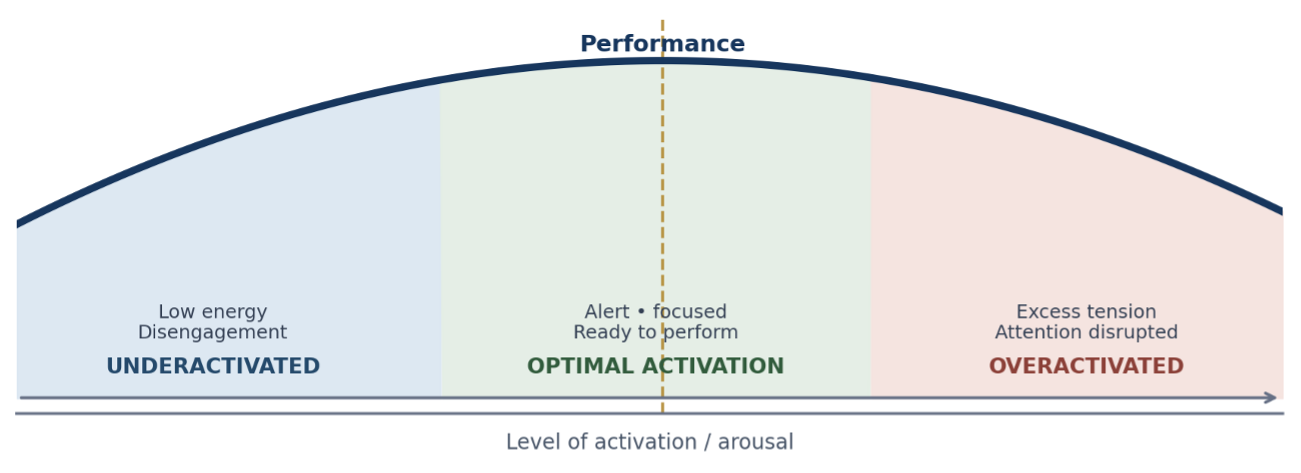
Underactivation can look like low energy, disengagement, sluggishness, or difficulty getting mentally started. At a more productive level of activation, a person may feel alert, engaged, ready, and able to direct attention to the task. At excessive levels, activation may contribute to rushed decisions, narrowed or scattered attention, intrusive thoughts, muscle tension, and difficulty retrieving information.
The practical lesson is important: the goal is not always to reduce activation as much as possible. Sometimes a person needs to become more alert and engaged. Sometimes they need to lower excessive activation. Sometimes they need to recognize that a degree of nervous energy is compatible with effective performance.
The model is a useful teaching framework, not a precise formula that predicts the ideal state for every person or every task. The most helpful level of activation can vary with the individual, the complexity of the examination, the type of task, and the circumstances. Coaching helps the test taker become more observant and flexible rather than chasing one supposedly perfect emotional state.
The Bill Cole Advantage: An Unusual Combination of Expertise
My work is informed by a combination of performance psychology, sports psychology, counseling psychology, stress management, mindfulness, and practical learning and test-taking strategies. I bring the perspective of a performance coach together with a background in counseling and psychotherapy. I hold a master’s degree in physical education with a specialization in sports psychology and a second master’s degree in counseling psychology. I was also the first person in the world to earn an undergraduate degree in sports psychology.
Over decades, I have worked with people across many performance settings, including athletes, executives, physicians, students, and other professionals. My experience coaching in high-pressure sports environments—including Olympic competition and major international events—has informed how I help people prepare for examinations. The setting may be different, but many of the mental demands are familiar: attention, confidence, emotional control, decision-making, preparation, and responding to pressure.
My earlier work as a psychotherapist and counselor also informs how I listen, assess, and understand the individual. A test taker is not a generic case of “test anxiety.” Each person brings a different history, learning pattern, set of pressures, strengths, habits, and goals. The work begins by understanding what is actually happening for that person.
Clients often tell me that they encounter tools, techniques, and strategies in our work that they had not been introduced to by other coaches or practitioners. I take that feedback as a reminder of the importance of breadth, customization, and practical teaching. A useful idea is not enough; a person needs to know how to apply it when studying, practicing, and taking the actual examination.
Three Performance Arenas: Study, Practice, and the Real Examination
I organize exam anxiety coaching around three connected arenas. Each presents different demands, and each deserves specific strategies.
1. Studying: Learn More Effectively
The first arena is learning the material. Anxiety can make studying feel chaotic: a person rereads without absorbing, jumps between topics, procrastinates, or spends so much time worrying about the volume of material that productive learning becomes difficult. Coaching can address study habits, comprehension, memory, planning, attention, and the ability to work in manageable, purposeful blocks.
I draw on a substantial collection of learning, study, and memory strategies. The aim is not simply to spend more hours studying. It is to make study time more effective, build a stronger command of the material, and improve the likelihood that information can be retrieved when needed.
2. Practice Examinations: Rehearse the Demands
The second arena is practice testing. Practice exams are not only a way to measure knowledge. They are opportunities to rehearse the conditions and decisions that will matter on the actual test: pacing, concentration, recovery after a difficult question, managing uncertainty, and maintaining effort over time.
A useful practice plan can deliberately include realistic time limits and testing conditions. Clients can learn to notice when their attention drifts, when negative self-talk begins, or when one difficult item disrupts their rhythm. They can then rehearse a response. The goal is to make effective behaviors more familiar before the stakes are highest.
3. The Actual Examination: Perform When It Counts
The third arena is the real examination. Here, the person must work with the conditions as they are—not as they wish they were. The room, the clock, the questions, the stakes, and the internal experience are all part of the situation. The test taker needs practical ways to return attention to the question, manage activation, recover from mistakes, and avoid allowing one moment to define the entire exam.
The strategies are designed to be straightforward and usable. Many are brief and can be applied discreetly, without drawing attention. Rather than relying on a lengthy routine that may not fit the exam environment, clients learn tools they can integrate into their normal study and testing behaviors.
Practical Skills, Not Just Good Advice
A central feature of my coaching is experiential learning. I do not want clients merely to hear an explanation and hope they remember it later. I want them to try the technique, notice what happens, understand when it may be useful, and practice applying it to their own study and examination situations.
The toolkit may include strategies for attention control, self-talk, breathing, centering, emotional regulation, confidence, visualization when useful, mindfulness, mental preparation, and recovery after a difficult moment. The specific combination depends on the individual. Some tools can be learned quickly and used in a matter of seconds; others require more exploration and repetition.
The aim is to build a flexible repertoire. A person should not be dependent on one technique, one app, one sound track, or one ideal setting. They should have options they can use in a quiet study room, during a timed practice exam, or in the middle of a high-stakes test.
Why One Technique Is Rarely the Whole Answer
Meditation, yoga, visualization, progressive muscle relaxation, music, mindfulness practices, cognitive behavioral strategies, dialectical behavior therapy skills, counseling, and medication may each have a role for some people. Their value depends on the person, the concern being addressed, the quality of the intervention, and the circumstances. None should be dismissed as universally ineffective.
At the same time, a technique that helps someone relax in one setting may not automatically transfer to a timed examination. A long exercise may be difficult to use when time is limited. A phone-based tool is never available in the testing room. A person may understand a concept intellectually but still need help translating it into a fast, practical response under pressure.
That is why I focus on transfer: Can the person use the skill when it matters? Does it fit the demands of studying and testing? Can it be adapted to the person's needs? Does it address the actual obstacle—whether that is attention, self-talk, perfectionism, pacing, emotional escalation, or something else?
My coaching can complement other supports a person may already have in place. It is not a substitute for medical or mental health care when that care is needed, and clients should make medication decisions with their qualified prescribers. The focus here is on adding performance-specific skills and strategies to the person's broader support system.
Customized Coaching for Different People and Different Examinations
Exam anxiety is not limited to one age group or educational setting. I have worked with learners from school age through college, graduate and professional programs, and people preparing for occupational, licensing, and board examinations. The demands of a middle-school science test are not the same as those of the MCAT, a bar examination, a medical board examination, or a professional certification test. The coaching must reflect those differences.
A medical professional preparing for a board examination may be dealing with career-defining stakes and a large body of technical material. A graduate student may be struggling with perfectionism and fear of disappointing others. A candidate who performs well on practice tests but freezes during the real examination may need a different plan from someone whose primary difficulty is organizing study time or sustaining concentration.
The first task is to identify the pattern. What happens before, during, and after studying? What changes during practice exams? What happens when the actual test begins? What has the person already tried? What works, even a little? From there, I can develop a customized plan and teach skills that address the person's specific needs.
Resources That Extend Beyond the Coaching Session
My work is supported by a substantial body of educational material, assessments, articles, checklists, and other learning resources. I have published numerous articles on exam anxiety and test stress, and have developed dozens of additional materials to support clients between sessions.
One resource is The Test Stress Success Manual, a 142-page guide containing more than 655 techniques, methods, checklists, and strategies related to test stress and academic performance. It is designed to give learners a broad range of ideas and practical tools rather than a single prescription. I am also preparing a second book in this field, Become a Savvy Test Taker.

These materials reinforce an important principle: people benefit from having multiple ways to understand and work with the challenges they face. The right tool is the one that fits the person, the task, and the moment.
What Clients Say About the Work
Client experiences offer a window into how these strategies can translate into real examination situations. One physician described preparing for a high-stakes ophthalmology board examination and learning skills that helped him feel focused and confident through a four-hour, 250-question test. Other clients have described improvements in concentration, the ability to recover when their minds begin to race, and a more manageable relationship with examinations.
A client preparing for the GMAT reported an 80-point score increase after coaching, moving from the 61st to the 83rd percentile, and later securing scholarship funding for an MBA at the University of Oxford. Another client described learning to recognize stress early, use countermeasures, and maintain mental and emotional balance during a demanding licensing examination.
These individual accounts are not guarantees of a particular result. They illustrate the kinds of challenges clients bring to the work and the practical changes they have reported. Each person's preparation, circumstances, and outcomes are different.
The Larger Goal: Learn to Perform to Your Potential
The Bill Cole Advantage is not a promise that anxiety will vanish, that every examination will feel easy, or that one method works for everyone. It is a comprehensive, individualized approach to the mental side of learning and performance.
The work combines an understanding of the person with the demands of the task. It addresses studying, practice examinations, and actual test performance. It recognizes that anxiety may need to be reduced at times, managed at other times, and sometimes understood as energy that can be redirected. It helps people recognize that they do not need perfect feelings or perfect conditions to take the next effective step.
A successful test taker is not necessarily someone who never feels nervous. It is someone who has learned how to respond when nervousness appears; how to regain attention after a distraction; how to recover after a difficult question; how to prepare intelligently; and how to keep working when the experience is uncomfortable.
Manage the anxiety. Master the mental game. Perform to your potential.
About Bill Cole
Bill Cole, MS, MA, is a performance psychology coach and consultant, former psychotherapist and counselor, and the founder of a distinctive approach to mental skills training for performance. His academic background includes a master's degree in physical education with a specialization in sports psychology and a master's degree in counseling psychology. His work draws on decades of experience helping people learn, prepare, and perform under pressure across academic, professional, and athletic settings.
Bill is the author of The Test Stress Success Manual and other books and educational resources. He works with students and professionals seeking to improve their study effectiveness, manage exam pressure, and perform more consistently.
Explore More
Free Re-Publishing Rights For This Article
You have our advance permission to republish this article, as long as you do not sell it. The author's name, web address (MentalGameCoach.com) and copyright notice (Copyright © Bill Cole, MS, MA) must appear in all reprinted articles. If the article appears on a website or in an e-zine, the article must include a link to a page in the MentalGameCoach website. We would also appreciate your including the author's bio and full contact information in your article, although this is not a requirement. For additional information, see our full article re-publishing permission guidelines.
