
Behavioral interviewing techniques use open-ended questions that require you to tell timelines of your behavior, thoughts, analysis, values and character, in story form. These are known as "competency-based" interviews that attempt to gauge your "behavioral competencies", where traditional interview questions cannot. This article describes this approach and gives you guidelines on preparing for and performing well in a behavioral interview. 656 words.

Behavioral Interviewing Techniques
Smart Strategies To Help You Master This Challenging Approach
Bill Cole, MS, MA
Founder and CEO
William B. Cole Consultants
Silicon Valley, California

Behavioral interviewing techniques ask open-ended questions that require you to tell timelines of your behavior, thoughts, analysis, values and character, in story form. These are known as "competency-based" interviews that attempt to gauge your "behavioral competencies", where traditional interview questions cannot. Behavioral interviewing techniques attempt to get at the real you behind your answer. This approach seeks to uncover your values, motivations, thinking patterns, likes, dislikes, preferences, temperament, style and all else that traditional questions often don't display. This article describes this approach and gives you guidelines on preparing for and performing well in a behavioral interview.
Behavioral interview technique questions begin like this:
- Tell me about a time when you...
- Describe a situation where you...
- What is your typical way of dealing with...
- What was your experience of ABC like?
- Give me a specific example of a time when you...
- Please discuss...
- Take me through your thinking about the XYZ project you did.
- Can you walk me through your analysis of the Smith project?
- What was the chain of events leading up to ABC?
You can see that you need to know your stories very, very well.
Using Behavioral Interviewing Techniques In Story Telling
I strongly suggest you learn to tell stories about yourself for use in interviews. People like to listen to stories, and stories transmit valuable content efficiently and in an entertaining fashion. Stories are perfect as a behavioral interviewing technique.
What does a good story have? A beginning, a middle and an end. It also has a story line that the listener can follow. It also has a moral, learning point or outcome you can summarize that describes the reason for telling the story. Based on that, you could frame your stories using the beginning, a middle, and an end, and name it B-M-E.
Other behavioral interviewing technique story telling formats include:
S–Situation
A–Action
R–Result
P–Problem
A–Action
R–Result
You need to know that even in the middle of your story, the interviewer may stop you and ask deeply probing questions about the story. You need to have thought the story through very well to be able to answer these. Obviously, if you are making up your stories, you may indeed have a problem when the interviewer begins to probe.
As one professional interviewer told me, "I ask people to tell me their professional story. As they tell about their journey, I get the larger picture of how they made decisions, what they were thinking, what their values are, and how they look at life."
Obviously, it is next to impossible to have ready a huge arsenal of stories that cover all situations you could possibly be asked. So instead, cultivate a representative set of stories about yourself that describe your good qualities, and then adapt and craft each one to fit the questions asked in the actual interview.
Choosing Behavioral Interviewing Techniques
Choose your behavioral interviewing techniques carefully. Here is what you might consider:
- Select a group of stories that are very positive about you and your accomplishments.
- Select another group of stories that are somewhat problematic or negative, but that end very positively about you.
- Vary the stories across areas of your life. Make some from childhood, some from college, some work and some personal.
- The stories should all make a specific point. If not, omit them.
- More recent stories are better than older stories, unless the older ones are powerful.
- Make your stories dramatic, colorful and with good detail of your strengths as they relate to the position you are seeking.
Behavioral interviewing techniques require you to prepare deeply and thoroughly, and to have many stories at your finger-tips. As you display your "behavioral competencies" through story form, the interviewer will get to know you more deeply as a person and business professional. If you enjoy the process of story telling, I know you will master the art of behavioral interviewing.
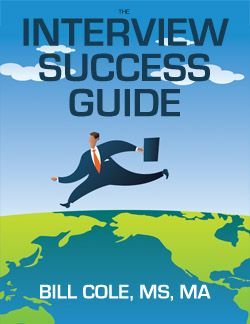
The Interview Success Guide Ebook
This article is an excerpt from the Interview Success Guide, an indispensable tool you need to make your interview campaign a big success. This is a 216-page master blueprint that helps you understand and navigate the interview process so you can mount a successful interview campaign. This book has deep, insightful and immediately applicable interview wisdom that demystifies the world of interviewing. It also has over 400 questions, listed by category, for a variety of careers and jobs, which you could be asked in an interview. There are also over 1200 interview task reminders, questions and guidelines in checklist form so you leave nothing to chance in your job hunt. This guide gives you a step-by-step approach to mastering the interview process. Everything you need to do, from the moment you begin your job hunt to when you accept the position, is covered. We have thought of everything you could possibly need to know to conduct a comprehensive, smart job hunt campaign. Learn more about The Interview Success Guide and purchase it in pdf format, downloadable directly from this website. The Interview Success Guide eBook is also available in Amazon Kindle format and Barnes & Noble Nook format.
To learn more about how interview coaching can help you improve your abilities in media situations, oral test and exam situations, and job interviews visit Bill Cole, MS, MA, the Mental Game Coach™, at: www.mentalgamecoach.com/Services/InterviewCoaching.
Bill Cole, MS, MA, a leading authority on peak performance, mental toughness and coaching, is founder and CEO of William B. Cole Consultants, a consulting firm that helps organizations and professionals achieve more success in business, life and sports. He is also the Founder and President of the International Mental Game Coaching Association (www.mentalgamecoaching.com), an organization dedicated to advancing the research, development, professionalism and growth of mental game coaching worldwide. He is a multiple Hall-Of-Fame honoree as an athlete, coach and school alumnus, an award-winning scholar-athlete, published book author and articles author, and has coached at the highest levels of major-league pro sports, big-time college athletics and corporate America. For a free, extensive article archive, or for questions and comments visit him at www.MentalGameCoach.com.
Free Re-Publishing Rights For This Article
You have our advance permission to republish this article, as long as you do not sell it. The author's name, web address (MentalGameCoach.com) and copyright notice (Copyright © Bill Cole, MS, MA) must appear in all reprinted articles. If the article appears on a website or in an e-zine, the article must include a link to a page in the MentalGameCoach website. We would also appreciate your including the author's bio and full contact information in your article, although this is not a requirement. For additional information, see our full article re-publishing permission guidelines.
Contact info
39116 Fremont Hub #1302
Fremont, CA 94538 United States
Phone: (510) 270-0311
Email: Bill at MentalGameCoach.com

William B. Cole Consultants name, design and related marks are trademarks of William B. Cole Consultants.
© 1997-2024 William B. Cole Consultants. All rights reserved.
Privacy Policy -
Legal Notices -
Digital Millennium Copyright Act (DMCA) Policies Notice